


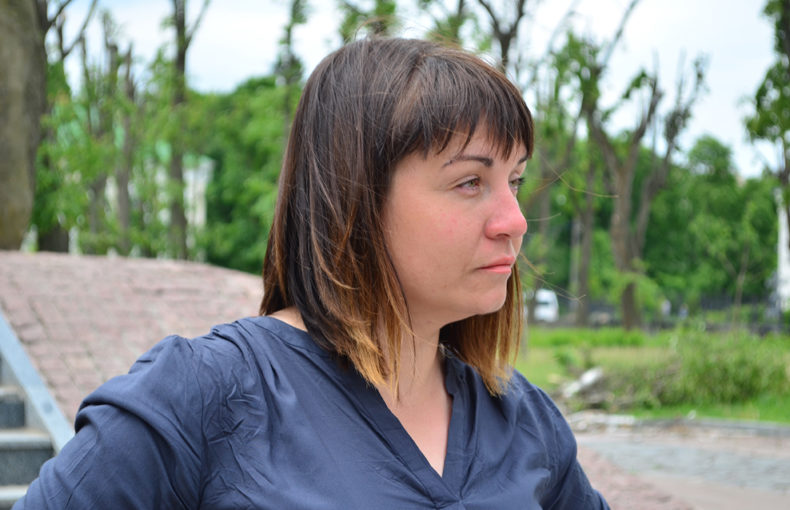
About the legendary dungeons and archaeological research in Zhytomyr do not speak only lazily. Therefore, we believe that we are incredibly fortunate, because we learned the truth from the primary source – from the participant of the Zhytomyr archaeological expedition Anna Petrauskene. About interesting finds, “archeological” jokes and everyday sciences specially for Zhytomyr.Travel
“I was everywhere: in the Carpathians, in Turkey. Yesterday, if I remember correctly, I turned (Laughs). I took the group to the campaign: there is such a tourist destination – mountain tourism. Turkey has a lot of interesting things! Just past impossible to pass, so many different ancient cities are interesting, ruins. There, of course, they are different from the cultural heritage, and they have something to keep. We have a slightly different situation, because our tree-earthen fortifications are not so well preserved. And there is a hard rock, limestone. Ancient Lycia – she is an ancient Lycia, with nothing to equalize”
“With Zhytomyr I have an invisible connection. We even bought an old-fashioned hut in the forest, very far away – the village of Zagreb, Malinskyi district, near Chopovich. Tell me why we bought it. We have an expedition in Zhytomyr region since the 90’s, my husband has been in charge of her work for over ten years. And we spend a lot of time in an expedition. In fact, we were living here in the Zhytomyr region. Therefore, they bought a house that is just half way from our house to Zhytomyr: it is more convenient to do “raids” to the sites of excavations ”
“In addition to the excavations, in Zhytomyr, we are implementing the project. His main idea is the tourist route “Drevlyanski hills”. Briefly, according to the example of the golden horseshoe of Lviv region, Cherkasy region, the route should connect the main Drevlian cities. And in each Drevlyanski hail of tourists will expect different places of interest among natural, architectural and other riches, and most importantly – archeological monuments. Here is an idea of archaeological tourism”
“The expedition works not only in large settlements. By the way, Zhytomyr, not long ago, was included in the list of cities in which works are being conducted. A lot of it was done in Korosten, and we started to appeal to other cities, so that we did research. Olevsk, Novohrad-Volynskyi, Malyn – there are simply chic mounds. There are good parks that can be brought to order, well, and archaeological finds. And in every city, these are unique things that are never repeated, unique sights”
“We are trying primarily to investigate where there is a threat of damage. Sometimes people build a garage, dig ditches and do not know what damages the historical heritage. We explore, document as much as possible so that this work has a historical benefit”
“Zhytomyr began to investigate from literally in 2017, and quite abruptly for us. Zhytomyr people realized that research has a meaning, because in fact, the last time the study is happening for the first time. Archaeological works were carried out earlier: exploration, study of burial mounds, classics of archeology have been here, but systematically, large areas began to dig only in 2017. That is so seriously – this is the first time in the history of the city”
“Urban archeology is very different: it is a huge number of different layers of the present, through which we just have to break through. That’s why on the Zamkova hill there were excavations? Here, when they began to build the archive, already the construction work was broken by the upper layer. Usually we remove a layer of building rubbish with a bulldozer, because it is difficult to do manually. Often we are diggers, and earth-all (Laughs). Therefore, once the construction has begun, archaeologists have been invited to look. Zhytomyr at that time was a mystery: as if it is like a big city, and there is no systematic archaeological research. And here came the proposal to conduct a full study. In 2016, we made small search boxes, looked at. And now the area is being studied enormously – 400 square meters. And they finished in December, in the twentieth numbers. It was lucky that December was not very rough, with no special frosts, but there was funding, and it was necessary to finish the work on time. And we made it: the new year we went to celebrate with a clear conscience”
“In fact, in every city there are a lot of history-fiction that are related to the past. We recently digged in Olevsk, and there was a cemetery near the church, dated around the 17th century. The most usual burials, but local such tales told! Grandfather came, says: “I live here all my life, I know that under the cemetery there is a dungeon. There you can go horses, and drive through the carriage. ” We asked to show where exactly. Says: “All, you do not believe me, I went” (Laughs)
“I was aware of Zhytomyr caves on the Internet that these are the caves of our Slavic ancestors. I already imagine how they lived there! (Smiles). Here is a “fresh” underground, literally somewhere in the 18th-19th centuries. What are the ancestors of the Slavs there? This is from ignorance, from the lack of information. Although sometimes these historical fables really have a foundation. As far as I know, the Zhytomyr dungeons are not caves, but different underground structures, warehouses and storage facilities that may have been related to the trading ranks intended for storing cranes, but these are some of the specialists involved. The expedition even invited consultant Timur Bobrovsky from Sophia of Kiev, a specialist in the study of underground structures, for expert assessment of the failures of the underground. I came and watched”
“When there were excavations in Zhytomyr, I found a post on facebook. The boy wrote that he and his comrades are digging underground passages, urgently needing help, asking to come to those who wish with shovels to join. It turned out that literally at a distance of hundred meters from us working illegal miners, who made a small pick up. And it really was quite near the roadway, and there was a danger that there would be a collapse. How can this be done in general? People without permission to carry out work, equipment, without helmets. Then they even called the police”
“How do people become archaeologists? Initially, they receive historical education, and then they have to choose a specialization. There is no separate archaeological education. There are now master’s programs, for example in Mohylyanka (National University of Kyiv-Mohyla Academy – ed.). That is, we must first become a historian”
“Difficulties in the work of archaeologists are numerous. First of all, it’s financing. It would be better, but we work with what is. Now, for example, we use private cars for transportation of things necessary for expedition. Sometimes it is a misunderstanding of ordinary people: it is believed that chemistry-physics should be taught, and history – “and to whom it is needed”, “everyone knows about it”. And, of course, “black diggers”. We do not even call them “black archaeologists.” It’s the diggers. Moreover, there are deputies and doctors among them, which sometimes do not even exist understand that something is wrong: “But it still lies in the ground.” I think their usual curiosity drives them, but I do not even understand how profitable it is. They do some research on open sources, tools are bought, then go to the “expedition”
“The expedition of archaeologists – it does not always live in tents and cook on the hearth. For example, in Olevsk, we were handed over to the premises by headrig. Such a hundred-meter hatch, in which we settled our way of life. And we got a very good deal! Though it does not look very stylish from the outside, but inside it is quite normal. There, we accept students of ZIFSU, we live there, and work side by side. And everyday problems are, as a rule, the smallest problems … It’s still interesting to put a nose under the ground, to see what is interesting there “(Laughs)
“In addition to research, we are making a reconstruction of what we dig out. It’s easier to understand what was once. Simply stick a pot – this is the minimum program. From now on we have the project “Ancient Water Vehicles”: we recreate the boats and swim on them. And this is quite fun! And with what not only to us, but also to those people who goes with us in a water trip. From such a scientific project on the results of archaeological excavations”
“When asked about the findings in expeditions, then the first thing I mention is that I also married in an expedition. Is this considered a discovery? (Laughs) And seriously, it happened differently: utensils, household implements, ornaments. From Olevsk they worked at the grave, found not only coffins and nails, but also a wedding ring on a woman’s finger. At that, the wedding ring was oxidized, and the fingers looked green, like some Martians. Metal is not expensive, but the find is interesting”
“We do not often find archaeological finds outside the museums. In Rome, for example, during the construction of a new underground line, part of the Eternal City was explored and many discoveries were made, and the results of work were exhibited in glass windows directly at the metro station, and people see these findings. We even tell a little bit about it. And although we have published several publications in Zhytomyr based on the results of the excavations, they are more scientific than popular science. Therefore, the average reader, they will probably not be completely interesting – not that genre”
“The scientist is not a profitable profession. More often people change this work to another, more realistic, landed. And the cases are different in archaeologists. From one time we made an obligatory archaeological examination of the object in the Kyiv region. It was in December, it was frosty. Specially trained men broke the top layer of soil with scum, and we worked very intensely to warm up. From such “scientific work”
“The greatest archeological joke is the dedication of students to archaeologists. Moreover, the limitations are exclusively in fantasy. In various expeditions differently: somewhere more tolerant leadership, somewhere not so, and somewhere simply and simply dress themselves in some clams and “torment” students. There are common rituals for all expeditions, for example, an oath. And sometimes there is something individual: to crawl under the shovels, to eat some kind of abomination. Calm some kind of mischief, and poor students must swear in eternal love for science. If near the water body, you can do water in the water, you can carry out the quiz. Somehow so, and it’s the most fun”
“Sometimes they invent some fables for the sake of tourist attractiveness. If such legends about the finds are adequate, then ok, why not? But sometimes something creates such an outrage that distorts historical truth. It is better to popularize what is, and not to invent frivolous things. Perhaps you just need to talk more about the history of your city”
Translated by Aliona Matushevich


