


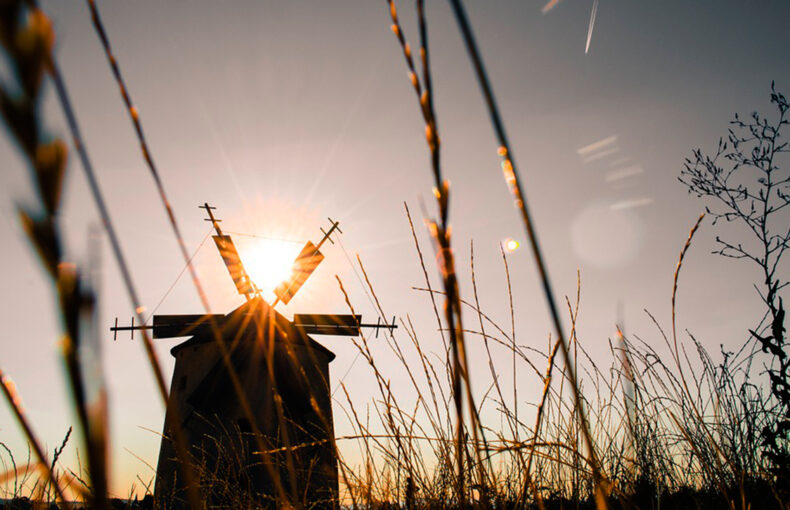
Some of our villages have a history that delights with interesting facts and wonderful stories. Today is about that
Three hundred years ago in Volhynia, just north of Chudniv, there was a large oak forest. On its picturesque meadows in the XVIII century a village gradually appeared, which received the eloquent name Dubyshche. On both banks of the river Teteriv, which flowed through the forest, people settled, built their homes and cultivated the land. There was a street on the left bank that started north of the place where the left tributary of the Budychyna flows into Teteriv and intersects with another tributary called Khvosa. At that time, the streets were connected by a wooden bridge built on stone supports. Behind the bridge stood the famous Dubyshche mill in the district – a witness of the past. When it was built is not known for sure. It’s a mystery, but old people say it existed more than 300 years ago. The building once had five floors, and eyewitnesses said that during the renovation of the walls they saw bricks made in 1600 in the village of Gremyachy. The fame of flour and cereals ground in Dubishche spread far and wide. Here they even made «nylivka» – especially finely ground flour of unsurpassed quality. Thanks to the use of advanced equipment at the time, at least six tons of grain were processed at the mill in five to six hours.
In the twenties of the last century, during the new economic policy, which remained in history under the name of the NEP, the mill was rented by an entrepreneur of German origin. The owner paid a fee for the ground grain – «mirchuk», or five kilograms of grain for one quintal. This provided profitability and income to a smart owner. A wooden granary was built next to the mill, from which a narrow-gauge railway was equipped for convenience. Unfortunately, in a few years the new economic policy was curtailed, entrepreneurs were dispersed and persecuted, and the composition was dismantled. Its remains in the form of building materials were transferred to the neighboring village of Tyutyunnyky for the construction of a school. The mill has since become state-owned. We will not miss those who worked here. For some time the director of the mill was a former employee of the Soviet secret services, the famous Toivo Vyakhya, known by the pseudonym Ivan Petrov. Lev Nikulin, a writer from Zhytomyr, wrote a book about him and his activities. There was even a feature film called Operation Trust.
During the Second World War and the Nazi occupation of the village, the mill also operated. Interestingly, local guerrillas sometimes managed to take flour out of it under cover of night for their own needs and to support the residents. In the postwar years, the mill became the cultural center of the village – there was a club, village library, there was even a movie theater and radio. At that time it was very rare. Famous athletes, artists from Zhytomyr, Kyiv and other big cities came here. And in 1964, a film crew from the Odessa film studio around the mill and inside created vivid episodes of the feature film «Daughter of Stration» based on the story of Vasyl Zemlyak – a writer, screenwriter who lived and worked in Zhytomyr for a long time.
The villagers always enjoyed gathering near the mill, where they could learn about events that took place in the country and abroad, take part in various entertainments or even a lottery. But times are changing: after the unification of Dubyshchensky and Novochudnivsky collective farms, the mill was stopped, the club gradually lost its appeal and ceased to interest the residents, and over time the city became abandoned. Many years passed before an article by journalist Leonid Susol about an old mill was published in a local newspaper in May 1989. In it, the author collected the thoughts and wishes of those who worked here and remembered the stories related to the Dubishche mill. They all called for the preservation of the local monument for posterity, regretting that human indifference destroys the historical and cultural heritage. At that time, the local authorities did not listen: in 1998, the mill was dismantled, and by order of the head of the collective farm, the wooden remains were distributed to the peasants for fuel or for construction.
Despite the fact that decades have passed, the residents of Dubishche do not forget about the monument and sometimes, calling someone, they say: «Let’s meet at the mill». Locals without geolocation will understand where you are if you say, «I’ve already passed the mill».
This is how life revolved around the old mill, which can now be seen only in yellowed photos or in the frames of an old film…


