


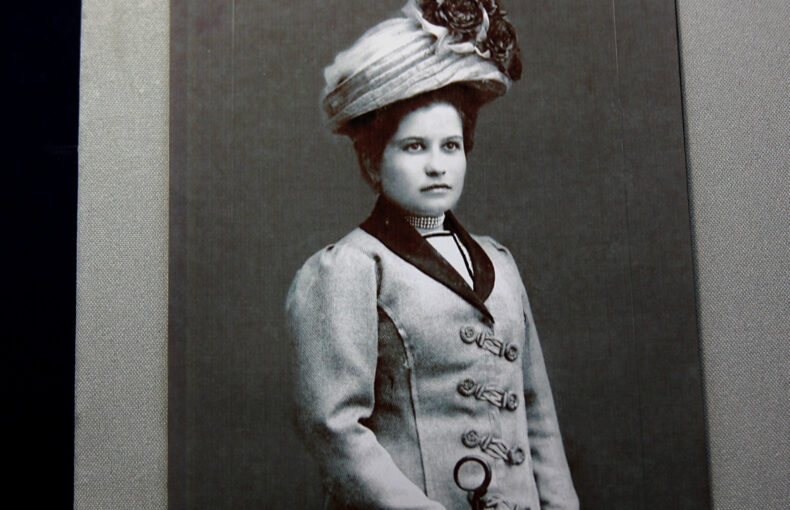
«A woman with a voice is a strong woman by definition» … These words of Melinda Hayes fully characterize the great Ukrainian singer Zoya Mykhailivna Haydai, who is often referred to as the «solar soprano»
Much has been written about the singer’s life. The fact that she was born in the family of the famous folklorist, choral conductor, composer and teacher Mykhailo Petrovych Haidai, and that the childhood and youth of the future vocalist are connected with Zhytomyr, can be easily found in Wikipedia. However, neither biographical data on the Ukrainian opera prima, nor walks on the street in Kyiv named after her, will hardly give us the opportunity to feel and understand what kind of person Zoya Haydai was. Much more memory is sometimes stored by small things.
The Zhytomyr Regional Museum of Local Lore has a lot of personal belongings and photos, but there is one small box with which big events are connected. In 1971, after Zoya Haydai’s death, the artist’s sister handed over a small rectangular chest to the museum, covered with brown silk on the sides and white on top. Embroidered floral ornaments and birds resemble the mysteriously delicate East. Inside – two compartments: in the small there are artificial eyelashes, in the big there is a black metal box with 7 recesses in which there are remnants of multi-colored make-up, as well as 4 brushes for applying make-up, a brush, 2 black pencils in metal cases, a bar of soap. But first of all there for a long time carefully stored memories …
As a child, in addition to a conscientious desire to learn, little Zoya willingly attended piano lessons at the Zhytomyr Music School. Studying at the Zhytomyr Mariinsky Gymnasium was a progressive step at the time, as in 1912, when the girl was sent to study, it was the first state secondary school for women in Volyn.
In addition to progressive views, since childhood the singer was accompanied by a love of music – it is unlikely that without this the world has seen the primo. Therefore, when the ardent educator and folklorist Mykhailo Haydai created a chapel of the Volyn Provincial Department of Public Education, his daughter Zoya not only became a member, but was the decoration of the choir for almost two years. Victor Kosenko noticed the gift of the future star. It was he who arranged her first solo concert, and then, on the composer’s recommendation, the girl entered the Lysenko Music and Drama Institute.
It is worth thanking the Zhytomyr Artists’ Union for its support: after considering the young singer’s talent, in 1923 she was sent to study. Years of study passed quickly, 1 in October 1928, the singer debuted as Liu in Puccini’s opera «Turandot», and a month later received another part – Tatiana from the opera «Eugene Onegin». Zoya Haydai’s brother, Mykhailo, recalls: «My sister was reincarnated instantly: she had just performed Tchaikovsky’s lyrical works and suddenly the tragedy of Grieg’s Under the Flowers romance, the world of experiences in Shaporin’s Curse.» Each party is a small life that the singer lived on stage. All this required strength, and Zoya Mikhailivna often listened in the Vladimir Cathedral to the metropolitan choir, led by her father, which, of course, did not like Soviet officials at all.
Smooth and flexible voice of a wide range, efficiency, inner strength – and the world has seen more than 50 musical and artistic images. The recognition was loud: at the I All-Union competition of musicians-performers in May 1933. In Moscow, Ukrainian diva Zoya Haydai won the first prize, became one of the first to win the Stalin Prize in 1941, and then passed the obligatory rank of Honored Artist of the USSR and received the title of «People’s» first of the USSR and soon People’s Artist of the USSR.
After the Second World War, the singer began touring abroad and performed in Iraq, Iran, China, Canada, USA, Pakistan. Of course, only «trustworthy» people were released abroad, and tours were usually propagandistic. One of them was a tour to China in 1952 as part of the «month of Soviet-Chinese friendship.» In addition to demonstrating talent and artistic achievements, the mission of the best artists of the multinational country was to create a positive image, so the tour group included not only representatives of different genres of art, but also people of different nationalities: ballet dancers Halyna Ulanova and Yuriy Kondratov, puppet actor and director Serhiy Obraztsov, Azerbaijani singer Rashid Majid ogli Beibutov, Uzbek dancer Tamara Khanum, Georgian illusionist Dick Chitashvili and Zoya Haydai, who performed the song in Chinese, Ukrainian folk songs «Oh, don’t shine, little moon», «Chumarochka ryabesenka», «Did I swim, did I wonder», «Oh, mother, my heart bloomed» and of course the classic aria.
The trip was one of the brightest impressions, because there, in Shanghai, Zoya Mikhailivna attended an opera performance and was amazed by the scale of what she saw. However, the singer has always evaluated her work too critically. Her brother recalls that even when the concert halls applauded while standing, the actress said that «today I sang so-so.» Strong, independent and demanding – this is how they knew the prima, the mistress of the «solar soprano». The images created by her are still remembered: Natalka in Lysenko’s opera «Natalka Poltavka», Oksana in Rimsky-Korsakov’s «Night Before Christmas», Mazhenka in Smetana’s «Sold Bride», Helena in Dankevich’s «Bohdan Khmelnytsky», Desdemona in «Othello» by Verdi, Margarita in «Faust» by Gounod, Snow Maiden in the opera of the same name by Rimsky-Korsakov, Butterfly in «Chio-chio-san» by Puccini.
Ten years after saying goodbye to the stage, in April 1965, Zoya Haydai died. Almost until the end of her life she taught at the Kyiv Conservatory (now the Tchaikovsky National Academy of Music of Ukraine) and kept memories of performances that glorified the Ukrainian singer in a small box until the last day.
Zhytomyr Museum of Local Lore is the custodian of the memory of the diva, proud of the presence in the collection of unique museum objects. And we are lucky with you, because here we can touch history.


