


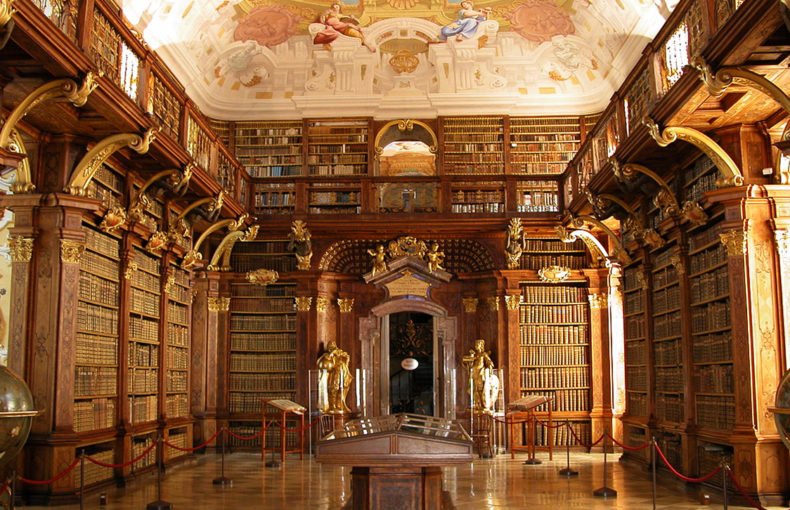
September 30 celebrate their professional holiday librarians, whose work is very old. The first libraries arose even in ancient times, and having their own library was always prestigious for rulers and wealthy people
Zhytomyr dwellers have a lot of pride: in our city, which was the “capital” of the Volyn province, since ancient times, unique, incredible cultural-historical value book gathering has been launched. This was promoted both by monastic, church and private libraries, whose owners were highly-cultivated and well-stocked families.
In 1835, the first public library was created in Zhytomyr. She did not last long, and a bit about her in the archives. But soon, in 1866, the main public library of Volhynia, which today has the name of Oleg Olzhych, was founded.
The impetus for its creation was not the desire of the royal authorities to give access to reading books to the general population, but political motives: the influence on the support and development of education on the foundations of nationality. So literally it was said in a letter-order addressed to Volyn governor Chertkov, written by Governor-General of the South-Western region Annekov. The collection of old rare books, which was accumulated in home libraries, was a common occurrence in gentry families. Libraries of great importance and significance from a scientific point of view arose in the estates of wealthy people and rulers of Volhynia. Local historians and researchers of the history of Zhytomyr are persistently studying the unsurpassed wealth and uniqueness of the funds of individual private libraries belonging to the families of Tereshchenko, Chaudoir, Galli, Tarnowski, Mezentsev, Ilyinskyi, and others.
Zhytomyr citizen Yevhen Bilenkyi, a candidate of historical sciences, devoted a lot of time and effort to studying the library collection of the Chaudoir family. According to him, the library contained about 40,000 volumes. It consisted of ancient manuscripts, first prints – incunabula, palaeo types (edited by the name of printed books), early printed publications, periodicals. The catalog of the library was contained in eight volumes, the books were marked by a highly artistic ex libris (with an ed., A book mark) with a heraldic emblem. A special place in the library belonged to the collection of manuscripts and letters. Currently they are kept in funds of the National Library of Ukraine named after V. Vernadsky. Among them are unique autographs, correspondence of historical figures of different epochs and states. On the documents – the signatures of French, Spanish, Polish kings, famous writers, philosophers, church and political figures.
Today, the name of the Zhytomyr Archpriest M. Trypolskyi, a researcher in the handwritten book culture, ethnographer, specialist in the history of the Volyn Orthodox fraternities and printing houses is not well known to the general public. Among the books of his library in Zhytomyr was the manuscript Gospel of 1571, which the researchers consider the list of Peresopnitsky’s copy. In addition to the Gospel, there was also the Ostroh Bible in 1581. Unfortunately, over time, books from the Tripolsky Library have disappeared, and the location of unique books is unknown. Where they are? Perhaps, by this time somewhere in Zhytomyr …
The history of especially significant bookshops of Zhytomyr is impossible without mention of the Volyn-Diocesan Ancient Reserve, founded in 1893 by Archbishop Modest on the initiative of historian, pedagogue, ethnographer Orest Fotinskyi.
At one time, Volyn had a significant educational influence on Lithuania, Poland, Belarus and Muscovy. Speaking at the opening of the ancient sanctuary, Orest Fotinskyi stressed that its launch, given the glorious historical past of the region, was dictated by the deep need for care for its history, for honoring the memory of the Volynians who supported, defended and defended their land, developed a spiritual heritage and collected libraries. After two incomplete years of activity, 537 manuscripts and 183 old-age books were registered in Volyn’s ancient reserve. The number of revenues increased rapidly. Among the described books were XV-XVII centuries from the library of the Dermansk monastery: “Prologue”, “Gospel”, “Works of St. Dionysius Areopagite”, “Pronunciation of Gregory the Theologian”, “Conversations of John Chrysostom”, “Collections of teachings and lives”. From Trigorsky monastery there were numerous documents, privileges, letters, letters to various monasteries, old books, in particular “Braviariia” (1767), Psalter of the typography of the Pochaev monastery (1789).
A special book treasure from the end of 1919 that struck its diverse composition and volume was the library of the Volyn State Museum of Local Lore (research) in Zhytomyr, which became the official place where nationalized book gatherings were kept. Famous libraries of Shoduariv, Tereshchenko, Ganski, Ilyinsky, Trigorskiy, Lyubarsky, Kodnunskyi and other monasteries came to the museum fund. Library bookshops were housed in houses owned by Baron I.M. Shoduara In a short period of time, a huge number of books came from different sources. Taking into account the circumstances of the time, historical events, insufficient number of employees, lack of necessary library knowledge, the accounting documentation contained only approximate information; sometimes these data simply capture the weight of pud’s revenues: for example, it was noted that “manuscripts, incunables, bibliographies, especially valuable publications received 250 pounds »
The incomplete list of the library’s library is impressive: Gospels and other liturgical books, treatises of historical and didactic content, chronicles, chronicles, lectures, spiritual poems, dramatic works, prescription drugs, historical collections and letters, library catalogs and inventory.
A number of handwritten books reflects the degree of studying spiritual subjects of compulsory disciplines: treatises on philosophy, theology, anatomy, physics, cosmography, poetics, rhetoric, etc. On the predominantly Latin-language manuscripts of the theological or didactic nature there are proprietary records that belonged to the teachers of individual disciplines, as well as the master’s records of libraries of various monasteries of the Right-Bank Ukraine. At the same time, the fund was transferred to the museum of the Catholic Seminary, a total of not less than 150 thousand books (5 thousand pounds), among which were very rare.
Many researchers describe the museum’s library collection. Among them there is a Slavic philologist, a researcher of the printed heritage P.M. Popov, who in 1934 prepared previously unpublished material “Manuscripts and old books of Zhytomyr funds”. In our time, his work has been published in 2007.
The existence of such a library contributed to the education, development of the cultural needs of the general population, and was the scientific basis for local lore and educational work.
But by that time, the Soviet authorities had pursued a targeted policy on the concentration of collections of pre-revolutionary books and documents in several central libraries and repositories of Ukraine in order to control their use.
In 1931-1934 by the decision of the People’s Commissariat of Education, the library of the central Volyn Museum was scattered across various bookshops. Historical sources that belonged to the “bourgeois culture” became historically superfluous.
Zhytomyr Museum was given an order to review the composition of its library funds and to transfer “dangerous” books to the National Library in Kyiv, or to the Kharkiv and Odessa Central Scientific Libraries. By the end of 1934 the most valuable part of the library of the Zhytomyr Museum was divided and transferred to various institutions of Ukraine. According to the Zhytomyr scientist Professor Mischuk SM, the library of the Volyn Museum until 1931 numbered more than 1 000 000 preservation units.
Why at all times so much power has given the authorities libraries? The answer is obvious: in libraries, the enormous strata of the centuries-old cultural heritage, which for millennia we collected and synthesized by our glorious ancestors, were concentrated. And today the book remains a source of wisdom and culture, which we so strive for, and the libraries are the place where the cultural present day of the nation takes place.
Serhii Sobchuk, Member of the National Union of Local History of Ukraine
Anna Sobchuk, co-author
In the article used materials of research S.Mishchuk, Ye. Bilenko, M. Kudrytskyi


