


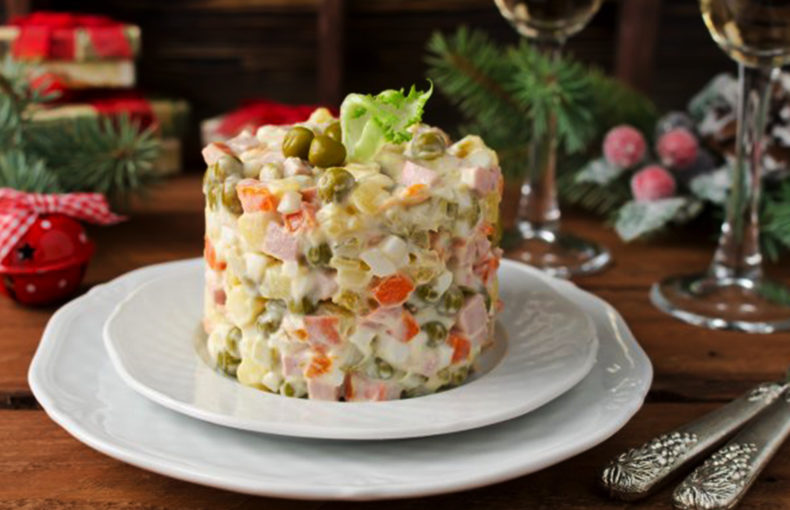
In the TOP of the New Year’s associations (Christmas tree, Grandfather Frost and Snow Maiden – out of competition) the overwhelming majority of us will name three things: tangerines, “Irony of fate” and Olivie salad. Since tangerines and must have New Year’s TV programs are more or less clear, then with the salad recipe is a real paradox: why the dish that we know since childhood is called the Olivie salad, who was Olivie? It turns out that there are so many riddles … And to solve them, one has to answer several questions
Question number 1 Where did Olivie come from? Especially ubiquitous culinary experts know the story of the appearance of the late nineteenth century. in the center of Moscow, a new, extremely fashionable restaurant, whose popularity was described even in fiction. It seems that the rich merchants of the time demanded from the owners of local luxury restaurants, which they themselves rejoiced abroad. And, taking advantage of the demand for foreign chic, one such Mr. Olivie opens a “palace of insatiability”, as his writer Volodymyr Gilyarovskyi calls: “The nobility so fluttered into a new French restaurant, where, besides the general hall and offices, there was a white room hall, in which one could order the same dinners that Olivie made in the mansions of the nobles. ” As recollections of contemporaries, at first the affairs of the restaurant were led by three Frenchmen, the main among which was Olivie himself. For special guests – Marius, in the kitchen – the Parisian cook Diego. Only the triumph of the restaurant ended quickly enough: “Olivier has not become. Marius, who devoutly treated the connoisseur gourmets, also served the merchants, but talked with them decisively and even condescendingly, and the cook Dooge no longer invented the merchandisers for new dishes and returned to his fatherland.
Question number 2 What is known about Olivie himself? In addition to the grave in the cemetery and the mysterious story of a salad recipe, a little about the fashion chef Olivie is known: he collaborated with Pegovy brothers, owners of the land plot on which the restaurant was built, and was involved in the work of the institution. At the same time, in one of the address books of 1868 there are some Nikolai Olivie, son of Joseph, the manager of the hotel, who had (attention!) The same name as the restaurant – the Hermitage. And only nine years later, according to the lists of 1877, Olivie appears on the list of merchants of the 2nd guild, but no longer Nikolai, and Lucien, a Frenchman, who lives in the house of Pegov! Agree, a strange coincidence that may cast a shadow on the French origin of the author of an immortal culinary masterpiece.
Question number 3 Was the concept of “salad” invented by Olivie? Now we are not talking about a puppeteer plant, but only about a dish that we perceive as a mixture of shredded products: vegetables, fruits, meat or eggs. Some historians quite confidently argue that the first time a dish is extremely similar to the Olivie salad, prepared chef Savoy court. The reason for the culinary invention at the end of the nineteenth century was the visit of the Russian emperor to Piedmont. Savoy chefs picked up ingredients that were well known in the homeland of the high guest, cooked, mixed and decorated with whipped cream that resembled the snow. Today, in the French menu, there is the “Piedmont” salad, which is very similar to the Olivie salad, and from the unusual for us there – only tomatoes
Question number 4 How did Nikolai-Lucien Olivie find out the recipe? There are two versions. One of them, late at night in a trendy restaurant, came to the military, but there were no chef’s companions there. And then, a desperate entrepreneur, in order to please the customers, went to the bank: crushed the products at hand, sprinkled with sauce and issued a “novelty”! Since Olivie himself cooked, then the next time, when ordering a salad, the guests sounded his name. The other version is not so skeptical about Olivie’s culinary abilities and does not spoil the well-known state of affairs: a talented cook prepared an extraordinary meal. All that contemporaries mention are the presence of mayonnaise in it. But about what was the mayonnaise of that time, it was written in the culinary book Olena Molochovets popular at that time, which was first published in 1861: “Mayonnaise is a meat or fish dish consisting of lanspike, it is cooked and false, and mousse, that is, a sticky meat or fish broth, whipped in a dense white foam, which is covered with fish, poultry or game, decorating the dish by the aforementioned lanspike. ” It is clear that Olivie cooked a long and meticulous dish, and uneducated guests took everything and immediately mixed up, not appreciating the masterpiece of “high cuisine.” Therefore, the next time the maestro was offended “joked”: he threw everything in succession, poured the sauce and mixed. But this variation liked it!
Question number 5 What happened after Olivie’s death? The salad, as the contemporaries of the cook-inventor testify, for some time served in the restaurant, where he worked himself, and in other institutions as well. The dishes and cooks of the “Bear” restaurant were prepared in Petersbourg and in Moscow, as mentioned by the same Gilyarovsky, commenting on the account from the Test House in 1897 or 1898. But those who were not lucky enough to visit the salad in the restaurant, absolutely needed a recipe. On numerous requests, the recipe was published in March 1894 in the number 6 of the journal “Our Food”, as if restoring it to the memories of those gourmets who were fortunate to lay the masterpiece exactly in the author’s performance. We bring him, but hardly anyone dares to prepare the following variant: “Fry the frost, cool, cut into small slices; cook walnut potatoes, slices, and slices of fresh cucumbers, then add capers and olives, mix and pour the following sauce: in the usual cold Provencal sauce add soy “Kabul” to a dark-colored and savory taste, masked on top with cucumbers, leaves salad, lettuce, and somewhat minced lanspik. Serve very cold in a crystal vase, like a fruit maseduan. In the winter, fresh cucumbers can be replaced by large pickles. Grouse can also be replaced with black grouse, partridge or chicken, but then the taste of the snack will no longer be so delicate. ” Well, regarding “capers” it is clear: we know them as capers, but the mysterious “soybean” Kabul “requires an explanation. Once soy was called any sauce, and without soy. In this recipe, most likely, we are talking about a spicy sauce borrowed by British colonialists from Afghanistan. Of course, there was burning pepper and vinegar, as well as meat or other soup, tomatoes and spices. A similar consistency on a mustard table, the sauce was added to “Provencal”, the recipe of which was much more mysterious. But mazduan is a dish made from fresh and slightly boiled fruit stuffed with syrup with the addition of liquor or brandy, with ice cream. Then the recipe of the famous salad was printed in several publications: in 1899 – in the book P.P. Oleksandrova-Ignatyeva “Practical foundations of culinary art”, in 1907 – in the culinary book of Z. Nezhentseva’s “Table book for owners”. Only no lanspike, no soybeans “Kabul”, no maseduan was there already.
Question number 6 How has the favorite salad of lord changed over time? After the turbulent events of 1917, life in the capital’s restaurants has considerably “calmed down”, and it is unlikely that gourmets could afford such gourmet dishes. But the love for tastes was also from gourmets from the proletariat. Therefore, when in 1939 the world saw the “Book of Tasty and Healthy Food”, which was at hand in almost every conscious mistress of the Soviet era, the dish was already called “Fowl Salad”. At the same time, the recipe reminds us very much of the salad that we now call “Olivie”: “Cut the hazel grouse, potatoes, gherkins, half of the boiled egg with thin slices, and the leaves of dried salad – into 3-4 parts. Put in a bowl, salt and mix with mayonnaise sauce, add soy-kabul, vinegar or lemon juice. Fried salad roll down the salad bowl. Inside the slides lay out the leaves of the salad, and in the circle decorate with eggs, chopped quarters, rings of fresh cucumber and pickles. You can decorate the salad with crab necks, slices of crab, and also circles of tomatoes. This salad can be cooked from a different game or poultry, meat, veal, etc. “Incidentally, in the same recipe, it is recommended to add sugar powder (hello from the Savoy chefs). In the 1952 edition, the salad again becomes a little more democratic: instead of pikelets and soybeans-kabul, the Southern comes with apples, tomatoes, garlic, onion, cinnamon, cardamom, raisins, clove, soya sauce and other ingredients.
Question number 7 Is it really a recipe for sophisticated and delicate salad to be lost forever? No matter what the riddles, the story did not tickle us, but the talent of Mr. Olivie was undoubtedly. Charisma, entrepreneurial skill and culinary fantasy immortalized his name with a simple and delicious meal. Today in the menu of many restaurants and cafes there is a salad with this name. And if Kyiv colleagues-restaurateurs surprise guests with exquisite dishes, adding smoked turkey or beef tongue, pikehouse or salmon, shrimp or avocado, then the restaurants in Zhytomyr are not very prone to experiments, and if they treat the New Year’s hit, then kind, close to the tastes of our childhood.
Well, and we are left with you today to rejoice that the dish has come to our times in the form of must have a New Year’s table. And let your own recipe is very simple or, on the contrary, extremely refined, in order to succeed in the new year, do not forget to add the main ingredients: love for what you do and the courage to start new business!
Translated by Aliona Matushevich


