


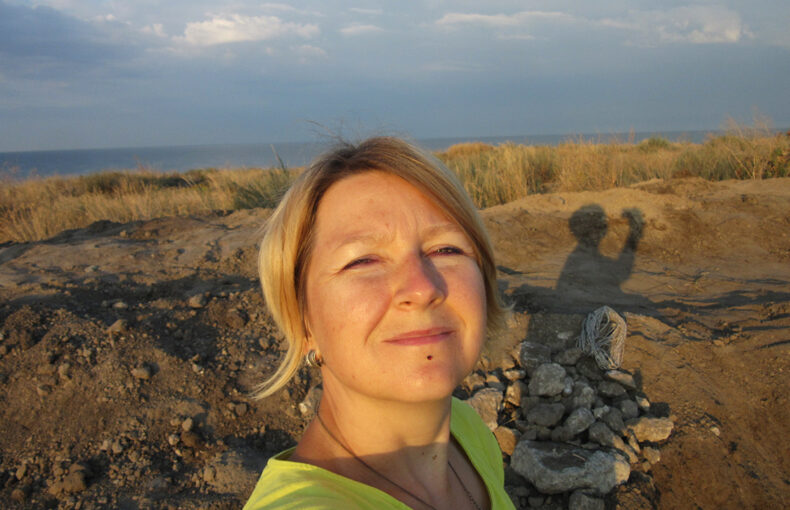
People have long dreamed of traveling to the future or the past. Although many fantasy novels about the «time machine» are considered fairy tales, it is possible to find a real opportunity to look into the past. Think of the archive – the place where our history is stored. Those who have never been there may think that they are bored there, but they are not. Some of the folders that form the funds store human lives and historical eras, and not everyone can imagine a living picture of the past, read the story, looking at the papers. Meeting with Oleksandra Buzko, Head of the Scientific Archives of the Institute of Archeology of the NAS of Ukraine, junior researcher of the Institute of Archeology of the NAS of Ukraine, author of about twenty scientific publications, gives an opportunity to look at the archive with different eyes
«An archive is a story. Many stories that are deeply hidden. On the surface – cardboard folders, dust. And when you dive into a document, into a knit of indistinguishable handwriting, wade through it, you begin to understand it better and better, the hooks turn into letters – then stories are opened to you, which, maybe, to anyone but you, and those people you read about, unknown. And that is mesmerizing»
«Honestly, I did not like history at school. I honestly read the textbook, but I could never remember all these dates, the stages of military operations, as the school curriculum required. I think it’s a problem not so much of my bad memory as our school history books. I don’t know, the textbooks may have changed a little now, but in the 90s it was a typical political event story, laid out in a dry and one-sided manner, completely unadapted for students, written with no intention and no interest. Later, at university, I learned about such a modern way of writing history as a microhistory – and it seemed to me such a nice place to escape from the event history, the history of wars, where you can slowly explore some local story, such as the life of one person against the background of great historical events. Ever since my school years, I was generally more interested in the history of literature and the history of philosophy – I liked to read biographies of writers and philosophers, their memoirs, correspondence, and portray their psychological portraits. Curious personalities were interested, which could not be clearly stated: here he is a hero, or he is a good man, an honest citizen. Interested individuals with complex characters. I remember the story of our university teacher about Rousseau, a sentimental romantic of the Enlightenment who put five of his own children in an orphanage. Or I wrote my first course about Richard Wagner, a world-renowned German composer and a terrible anti-Semite at the same time»
«In fact, it happened that interest in biographies of prominent personalities was later reflected in the topic of my dissertation – I work in the archive with the Ukrainian archeologist Maria Ivanivna Vyazmitina Foundation and write her scientific biography. This is a Kyiv scientist who entered the history of Ukrainian science as a researcher of Sarmatians and Late Scythians in Ukrainian lands, but began her archaeological career in Central Asia, working on two large-scale expeditions by the Uzbek archaeologist Mykhailo Masson-Termezstin and the South Turkmen. There she excavated a Greco-Buddhist temple of the Kushana Empire and the New Nisa Parthian settlement. If it was customary for Russian archaeologists to go from a metropolis with expeditions to «fraternal» Soviet republics, then in Ukraine, few people have participated in such projects. Therefore, this story of Mary Vyazmitina’s life is quite interesting. In general, she lived a long, busy life, associating in youth with both Ukrainian futurists and Russian symbolists (she was a frequent visitor to the House of Poet Maximilian Voloshin in Koktebel). and life began in the Russian Empire, most of which took place in the USSR and ended in independent Ukraine (years of life: 1896 – 1994). That is, her biography can be viewed against the backdrop of almost a hundred years of history of the three states – and this way of research – local on the background of the general – impresses me»
«My years of study at the school – the 90s and the beginning of the 00’s – at that time there was already a revision of the view on Ukrainian history. In addition, I studied in the Kiev high school, where there was a clear «roll» towards Ukrainianization … In the lessons of Ukrainian literature, we began to study the writers of «shot revival», learned about these terrible days and in the lessons of Ukrainian history»
«Already in university years we in Mogilyanka had such a course – «Culture of the Soviet era». I don’t know if they read it now. I found just the first test course developed by two wonderful teachers of ours – Mykhailo Anatoliovych Sobutsky and Borys Mykolaiovych Chumachenko. By that time we had already listened to their courses on Ancient Greece and Rome, about the Middle Ages. And then this one happened. Apparently, it was such an attempt to isolate in that era a significant – both terrible and purely human. Of course, this was not a course about social realism, but about certain phenomena that fell out of the official scheme, from the view of culture by the party nomenclature»
«In my youth, I loved the philosopher Friedrich Nietzsche, it was such a youthful maximalist hobby. I read a book by Daniel Halev in the upper grades, «The Life of Friedrich Nietzsche» – and somehow so vividly imagined all his life and suffering, at the end of the book I cried very much. But Nietzsche is far, I know German quite badly, and in the world somehow enough of his biographers without me. Instead, in 2013, I came to work in the archive – and here the figures of Ukrainian culture and science opened for me, and for the first time I was really interested here. And especially my Maria Ivanivna Vyazmitina. I say «mine»- because when I disassemble her fund, I read letters to her, drafts of her letters, notebooks, diaries. With all these documents, her figure literally comes to life in my imagination. By the way, the Publishing House has recently released two wonderful books for children, «She Did It» and «She Did It, too» with biographies of famous, and undeservedly forgotten, Ukrainian women – scientists, artists, writers – easily written and beautifully illustrated. Among them is the story of Maria Vyazmitina, presented by Olga Pacel, and the illustration – a beautiful plasticine portrait made by artist Olga Protasova»
«In addition to the Maria Vyazmytna Foundation, which is the closest to me right now, the oldest holdings in the archives include the Museum of Antiquities of the Kiev University of St. Volodymyr, the VUAK Foundation (All-Ukrainian Archeological Committee – the precursor to the Institute of Archeology), personal funds of archaeologists Fedir Vovk,Vikentiy Khvoyka,Serhiy Gamchenko, Peter Kurinsky, Danylo Shcherbakovsky, Theodosius Movchanovsky, Alexander Fedorovsky, Sylvester Magura, Kirill Korshak. Many of these archaeologists had a tragic fate – they were repressed and did not survive in the 1930s»
«At the end of the XIX – beginning of the XX century, the history of archeology was represented mainly by male names, because women were only eligible for higher education at that time. However, since the 1870s, higher women’s courses have begun to open in the Russian Empire – in Moscow, St. Petersburg, Kazan, and since 1878 – in Kyiv. Women also appear in archeology. We have manuscripts of the Countess of Praskovia Uvarova, in particular her letters to archeologists Vikentiy Khvoyka and Serhiy Gamchenko. Letters from Valery Kozlovska to Vikentiy Khvoyka and Peter Kurinsky. There are letters and scientific works by Irina Fabritsius, Eugene Pokrovskaya, Eugenia Makhno, Elena Lagodovskaya, Varvara Ilyinska, Halyna Mezentseva. Unfortunately, a number of funds have not yet been described – the funds of Riva Wetstein, Olympiada Shaposhnikova, Tamara Movsha, Anna Nekrasova, Valentyna Krapivina, Nina Leipunskaya, Sofia Berezanska, Elena Parshina. Most of these names may not be known to the general public, but these women have made significant contributions to science and their names are inscribed in the history of archeology. So although archeology is considered a more stereotypically more masculine profession, we can see that many talented women have worked and worked in it. Most women, apparently, were at the Institute of Archeology in the aftermath of World War II»
«There are stereotyped statements about the archive. For example, documents are heavily dusted and archived by strange, rebellious people, canned in time and dusted by the same archival dust. Unfortunately, we still have enough dust – this can even be an allergy. But the people we work with are very friendly, although they are sorely short. There are currently two staff members: Halyna Stanitsyna, who headed the archive in the 1990s and 2000s, and Dasha Romanenko, who just graduated from the Shevchenko University School of History. Halyna Oleksandrivna knows the archive well, has extensive experience and many publications based on archival materials, describes archaeologists’ personal funds, and Dasha is very honest, quickly learns and promptly describes new archaeological reports on excavations in Ukraine, which are receiving a great deal every year. We also serve a large number of scholarly readers who come to the archives to work with documents»
«We can get a lot of information from letters. Friendly and working correspondence, service telegrams – all this sheds light on those events that are not described in the official autobiographies of scientists, in their obituaries. We now have e-mail – and we do not know how it will be archived. These are the challenges of the digital age that are already facing us»
«There are amazing finds in the archive. Recently, I was browsing a huge array of letters from art critic and ethnographer Eugene Spassky to Maria Vyazmitina. They were friends in Kyiv and studied together, and then, in 1934, Spassky was without special explanation sent the Soviet authorities to Kazakhstan. There she stayed for life and until she returned to Kyiv, however, she continued to write letters to Kyiv to her friends of youth. And so among the letters I came across an envelope from which something protruded slightly. I discovered – and there a piece of granite from which, as it was written in the letter, made a plate on the grave of Eugene Spassky in 1981. This is her son sent to Maria Vyazmitina from distant Kazakhstan after the death of mother»
«This is a thoughtful find of our former employee Igor Tseunov. This is a denunciation of the 1870s to the archaeologist, ethnographer and anthropologist Fedir Vovk, signed by the fund-maker as «Testimony of the Kyiv traitor Velednitsky.» According to the document, in this era of nihilism and free thinking, progressive youth gathered at the «radical apartment» in Vovk and read Marx, Fichte, Feuerbach. Among the participants of the circle were famous persons: Mykola Lysenko, Pavlo Chubinsky, Mykhailo Staritsky, Vladymyr Antonovych, Mykhailo Drahomanov. At the meetings, they discussed the project of the Ukrainophile Party, quarreled with the Russian monarchical system and allegedly corrupted the youth with ideas of nihilism, denial of religion, family and homeland. I do not know if you can trust the reporter, but, according to his testimony, Fedir Vovk crossed his son into nihilism, pouring beer for singing songs. Unfortunately, we know little about such «living» stories about Ukrainian intellectuals of the time. At least from the school curriculum, I don’t remember that»
«Another accidental and extremely interesting find of the last year is the still unknown manuscript of the novel by V. Domontovich (the literary alias of the archeologist, ethnographer and philosopher Victor Petrov). Literary scholar and writer Vyacheslav Levitsky came to our archive to get acquainted with the propaganda tale of V. Petrov «Shchors», which was preserved in the fund together with the purely archeological works of the scientist – and on the back sheets of the manuscript of this tale found a black girl’s draft. If it weren’t for the archive, apparently I would be working on another job that brings in more money. But I like the archive more than the money if I continue to work here. (Laughs). It is quite possible that I would associate her life with cinema: l was preparing to enter Karpenko-Kary University for directing, but I had a competition in “Mohyla” (ed. National University «Kyiv-Mohylianska Academy») for specialty «Culturology» , so I thought it was a good basic education. In my senior years, I was drawn from somewhat abstract cultural studies to archeology, where you can hold artifacts in your hands – objects of your study – and I completed a master’s program in archeology. Since then, I have not been interested in the direction, the history of science was all I was interested in»
«I have no professional prejudices. With years comes awareness of certain rules and professional ethics. As a non-religious person, and to some extent cynical, I used to be somewhat light-hearted about the bones of ancient burials. But after listening to anthropologists who deal with human skeletons – studying traumas, diseases, diets, people’s way of life in ancient times, I now understand that these human remains must be treated with great delicacy. During archeological excavations, we disturb the burial -and the burials must be treated respectfully and with appropriate tact»
«Archival work is very time consuming. At present, I work more with paper than with earth, since the object of my current research is not the archeological artifacts, but the figure of the researcher – Maria Vyazmitina. However, in order to better understand what she was doing, the material culture of the later Scythians, it was useful for me, for example, to work on the excavations of the Late Scythian Red Lighthouse in Kherson. Along with the 1950s, Vyazmitina worked at the synchronous settlement and the Golden Beam burial ground. So, although archival and archaeological work is different, it is interesting to combine them sometimes»
«Unfortunately, now archeology is not as popular with young people as we would like. Instead, the so-called «treasure hunt» is popular. It’s a scourge that literally erases our history as a virus on a computer. Apparently, we all have such a conditional classmate, or distant relative, who somewhere with a metal detector walks the fields in search of jewelry, and thinks at the same time that he is an archeologist. No, he’s not an archeologist. Archeology is a very complex science with its methods and tasks. Often, such people say,
«As long as those archaeologists dig, it will rot in the ground.» It wouldn’t rot. For thousands of years it lay in the ground – it will last another half a century if needed. Science is not standing still, and now, because of the rapid development of technology, even more so»
«Even now, the technical means make it possible to scan the earth, to explore the monument without even digging it, the so-called non-invasive methods. At the same time there are metal detectors in the free market. And if they help archaeologists, then in the hands of treasurers they become evil. How archaeologists work? They lay a large excavation, divide it into squares and then layer the earth in layers, fixing the type of burial, housing construction, photographing finds and making all the necessary sketches and drawings, keeping a detailed field diary. Then the findings are deposited in the funds and museums, and a written report – in our archive. Professional archeologists do not run for the sensations, because they are a metal fibula, and the ceramic pot tells how people lived in antiquity. To reconstruct the life of an ancient man by material remains is the task of archeology. What do Treasure Hunters do with the help of a metal detector? They literally pull metal from the ground – that is, they are deprived of the context, and the memo – dating material. If the burial or dwelling is destroyed by robbery, we will no longer know the owner of that fibula or coin: when and how he lived, what he did, from what utensils he came from. Whether it was a man or a woman. For example, if you rip out arrows from a woman’s burial, the story of Scythian warrior women, the Amazons, would be incomplete. All this romance – «treasure hunters» do not understand, because they have never been at the real excavations. they have never been a real excavation. By the way, many expeditions are looking for volunteers in the field season, so you can always get involved in professional excavations. By the way, many expeditions are looking for volunteers in the field season, so you can always get involved in professional excavations – if there is a wish»
«I came to Zhytomyr in the summer. We planned to celebrate the 160th anniversary of the prominent Ukrainian archaeologist Sehiy Gamchenko, whose fund is kept in our archive. He conducted many archaeological excavations here, there is a street in Zhytomyr, named after the Gamchenko family. In winter, we submitted a project about Gamchenko to the Ukrainian Cultural Fund, but there is such a frantic competition this year that, unfortunately, the project will not receive funding. We wanted to digitize the foundation, put the documents into free access to a new, modern web resource, and adapt custom software. Many think that it is enough to scan the documents and a lot of «pour» on the site. No, you need a special program that allows you to do a page-by-step description – to fill in so-called metadata. This requires serious archive collaboration with the programmer. We also planned to make an exhibition of materials from the Gamchenko excavations at the Zhytomyr Regional Museum, which are stored there in the funds. Unfortunately, at this time, we cannot do this without financial support. I still have no hope that there will be, perhaps, patronage support – for the project to be completed by the end of the year, at least to some extent. It is this year the 160th anniversary of this distinguished scientist. In the summer in Korosten, Andriy Petrauskas, scientist, archeologist who works extensively in the Zhytomyr region, held an international scientific conference on «Drevlyanski grads: the early cities of Eastern Europe» within the Dobryn-Fest. We dedicated it to the memory to Serhiy Gamchenko. There were a number of reports on his biography and scientific achievements that would be desirable to be published as a separate collection»
«In Zhytomyr, Serhiy Gamchenko died in 1932, most likely from starvation. The year of his death is sometimes misrepresented in the literature as in 1934. But Zhytomyr archaeologist Alexander Tarabukin, a good expert in Gamchenko’s work, has established the correct year for the same archival documents. In preparing my report for the conference, I also came across the find of researcher Iryna Khodak – a letter from Natalia Kotsyubynska, an art critic who was shot in 1938. She wrote in a letter that she would make a report on the late Gamchenko (letter dated 1932). As she states in the letter, Gamchenko was very distressed before death»
«During the quarantine, I would advise less panicked to read a piece of disappointing news, to try to control dependence on social networks. In order to train the willpower, I would read the Roman Stoics now – Moral Letters to Lucilius by Seneca, Alone with Me by Marcus Aurelius. It seems to me that stoic philosophy best supports the morale in difficult quarantine conditions. And for those who love story literature – the novels of Victor Domontovich (Petrov), The Girl with the Bear, Doctor Seraphicus, Without Soil, Kulish’s Novels, Alina and Kostomarov. They are freely available online. I remember him not simply because he was an archaeologist, and his foundation is in the archive. In fact, I discovered it as a writer back in my school years. And only then found in the archive here for him his foundation. In the 1950s, Victor Petrov even directed the work of our archive. I must say that this is a complex and ambiguous personality, but at the same time a talented, sometimes paradoxical author of prose, which was lacking in our classical literature – urban, such, somewhat anti-populist. Solomiya Pavlychko called him the Sphinx and Mephistopheles of Ukrainian culture. Now colleagues at the Department of Ukrainian Studies at Jagiellonian University are preparing to translate and publish a three-volume of his works in Polish. Therefore, knowing and appreciating it in Ukraine will not hurt us more»


