


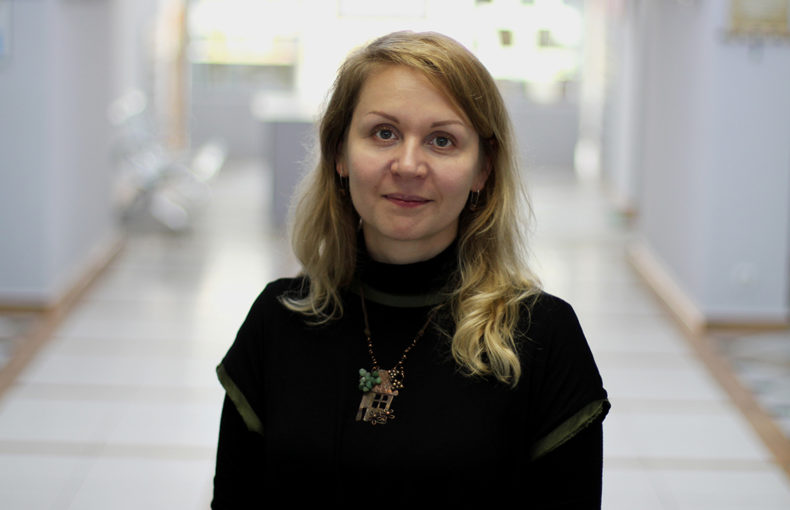
Doctor of psychological sciences, psychotherapist, author of the book “Education without injury, or why adult children?” Through which thousands of Ukrainian parents found answers to complicated issues concerning the education of their children, Victoria Horbunova told us about why silence and excessive burns and The sacrifice of parents is harmful to family relationships
“At one time I did not have the opportunity to choose a dreamed profession. But I wanted to become an engineer of deep cold, like my parents. It was just fascinated by their stories about bright and fun student life, that your inventions can fly in space. To do this, we had to go to Odessa to study at the Academy of Colds. In that difficult time for our family this was an overwhelming financial burden, so stopped at the fact that it was close at Zhytomyr State University named after Franko. And from those specialties that I could then choose, the most interesting was psychology. The psychologist seemed to me like a cryogenic scientist: there are also many mysteries, and the matter is just as fragile and compelling in the work”
“When I’m asked if it’s easy for me to combine motherhood, teaching, scholarly, writer’s work and psychotherapeutic practice, I answer that I have never tried to combine anything in my life. I just lived and lived. A friend with those I work with, with whom I study, and with those I teach. I write a book on work and life: my own and my clients and friends. I’m exploring what is interesting. All these roles are related, confused and inseparable. As a therapist, I can not (and do not see) the “switch off” in myself a scientist, not a mother or a writer”
“There is no universal secret for marital happiness, because there simply does not exist the same pairs or the best recipe. They all have their own history, experience, expectations, dreams. The only thing I know for sure is that happiness, and love is a verb. Of course, as a psychotherapist, I can tell partners the mechanisms of their conflicts, figure out the causes, suggest options, even show and help try other strategies of interaction … But if they will not do anything at the door of the cabinet – nothing will change in their lives. I have no pills from marital treason, no gypsum for broken hopes … ”
“The most harmful habit in marital life is the habit of silence. Do not talk about feelings, expectations, harassment, desire, not to talk about what happened outside the family, not to share plans, to think that the other should understand without words, to guess, to know and so on. I do not know who and when “gave” to us the installation that love must be proved by business, not words. There are growing whole generations of people who do not feel loved, because of this is a shame on the words of love. We seem to know that we are loved, but we do not feel it, and that’s why we lose love. Say words! You know how I rejoice at the fact that my dad’s phone is recorded as “Beloved” on my mom’s phone! Every time he calls her, this is the word that glows on the screen, and it matters”
“It is accepted that parents should not find out about relationships in the eyes of their children. Perhaps this is not good – children grow up in anxiety. And you know what happens when couples try not to quarrel in the eyes of their children? Children see and feel that something is going wrong, they can hear echoes of quarrels behind the closed doors, feel the cold and evil views, which parents shoot from each other, to be surprised by sharp responses, to always face it all, because it flies in the air. Children see, feel, but do not understand what is happening – they are beginning to invent their explanations of the situation that has developed. Children often think that they are guilty of something, or imagine that their parents are about to be divorced. I do not see any problems in order to quarrel and tolerate in the eyes of children: to show them how conflicts are resolved, how to do it, to admit their wrong, to apologize, to forgive each other and to hug one another. All this is a very important skill to learn, and where to do it, if not in the family? True, at first parents should learn this art”
“A happy child grows up in a happy family. Stop giving the most delicious piece, sacrifice yourself and your time, give up sleep, travel and other opportunities for the sake of children. All this will not add to the little children or the crumbs of happiness. Instead, the sense of guilt, the feeling that you are guilty of something to someone, that you do not deserve love, another such mental waste will be with a topstick. If you want to see your child confident, persistent, purposeful, critically minded, you must understand that all these things do not arise out of nothing. Surround your children with valued people and do not feed yourself back: learn with interest, work for pleasure, stand up for your dignity, enjoy life …”
“Going to psychotherapists is gradually becoming not so much a fashion as a usual practice, and it pleases. People go to the specialists to understand themselves, to establish relationships when faced with problems in the upbringing of children. After all, in schools and universities we are taught something for nothing, except for the most important thing – to build relationships, resolve conflicts, maintain and receive support, seek resources. The number of Ukrainian psychotherapists that can work effectively with mental health disorders (depression, anxiety, phobias, obsessions, panic attacks, etc.) increases every year”
“Several years ago, my husband and I were invited to work at the Ukrainian Catholic University. The decision to try to live and work in Lviv was not particularly difficult, because it sounded like this: “try to live”. We tried – done a lot, deprived, I’m sure, a good trace (at that time, the first in Ukraine, the Master’s program in Clinical Psychology, out of dozens of projects implemented, the largest of which – the Center for Traumatic Therapy and Psychological Assistance “Space of Hope,” in which worked the true multidisciplinary team) and went further. I think it’s quite natural. Interestingly, I no longer perceive myself as a person of a university, and I think I will never agree to an administrative post. At least until I see the opportunities to work for pleasure and in order to achieve concrete results, without daily overcoming, buy insurmountable obstacles. I’m thrown in a non-state position, lack of patriotism and much more. But I’m sure that as a psychotherapeutic, a freelance teacher, author of projects, a writer, a scientist, I can do much more for my country than the director of a university unit who is imprisoned”
“Now I am gradually teaching at the Ukrainian Catholic University, and at the Zhytomyr Ivan Franko State University. This is a very different high school. Each of them arose and grew in its own way, and they were led by different people in different directions. It is interesting that inside these universities are very heterogeneous. If I talk about UCU, then I teach at two different faculties and, interestingly, these faculties are very different, I would say – fundamentally different as in one university: each has its own special corporate culture, vision and values. Once upon a time, with such a striking value inhomogeneity within one university, I encountered the ZSU. The Social Psychological Faculty, which I was fortunate enough to create and develop with the teacher, Oleksandr Muzyka and our team, was not just different, he was fundamentally different. We did not know what kind of plagiarism, neglect, gossip, dragging blankets … The faculty had dozens of victories! Our graduates scattered around the world: they work, defend thesis, study in leading universities of the world”
“For several years now, with my husband, we are investigating the psychological consequences of the Holodomor in the minds of Ukrainians. Now we are working on the results, have already prepared an article to be published, which is currently being interpreted by native speakers, since it will be published in English. The most interesting thing is the world-views and behavioral strategies that followed the Ukrainians. Here, the specific accumulation of food and the experience of the fact that the child eats poorly, and lack of confidence in the authorities, and the desire to seek better luck in other countries, and reservations about the number of children in the family to be fed, and permission to theft in the place where you work, and much more. Incidentally, the fact that people in their families whose history of the Holodomor was tabooed more often devalues the events themselves and does not consider it necessary to honor the memory of the dead, for example, to light the candles on the anniversary, is rather interesting. Many of them still believe that there was no Holodomor, but only lazy and alcoholics were dying. Actually, this is another proof of the fact that silence is harmful”
“I like traveling. On trips I’m trying to try the world on myself. I try to see the countries, the cities, and try to understand them, whether I could live here, or could become a part of this different culture, an organic particle, and not an alien body. I do not know … I dream that my son will be free in the world – to choose for himself the place that he most likes for a certain period of life. To be free in the world while remaining Ukrainian. I think that I will not succeed, but in my power to enable it for my own child, to enable the ability to feel natural and organic everywhere in the world”
“I love to sleep very badly. Sleep in full darkness, silence and cool under a warm, warm blanket, on a soft cushion. And love to fall asleep after I read. Let it be late, let me not at home, and at the hotel or in the house of friends, I will not fall asleep until I have seen at least a few pages. I also love hugging. I have a very “obsmultivnaya” child, husband and friends. As for me, it’s good to sleep, it’s fun to read and warm yourself – the best lessons for free time”
“I do not like some words. For example, I do not like the word “self-esteem”, because it forces us to wear an interior roaster in ourselves, to constantly evaluate and compare ourselves with others. Much better is the word “self-worth”, which suggests not to evaluate, but to appreciate both oneself and others. I do not like the word “success” as well. Etymologically, it “throws itself” to a hurry, to the desire to quickly achieve something, to catch up with the thai run over. That’s how we perceive life’s success: running, racing, achievements, rewards, recognition, accomplishment. No. I got caught up. Now I try to walk slowly, attentively, listening and looking. Around so much important and interesting, so incredible, and all of this we risk not to notice in pursuit of success. This is very difficult: do not seek success, but rather notice important, appreciate people, love to live. I still study this and try to teach my students, clients, son”
Translated by Aliona Matushevich


