


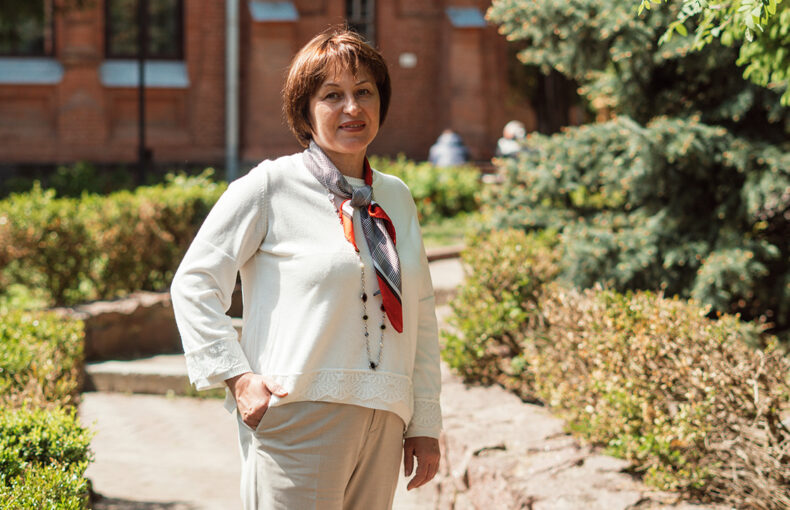
In the novel «The Master and Margarita» one of the heroes of Mikhail Bulgakov says: «History will judge us». Do you think history can actually find the right and the guilty? In addition, you should ask yourself what history is just for you: are it just numbers and facts, or the fate of people who once lived? Even if history is just a school subject for you, you may be struck by facts about your hometown or your family members. We talked about different views on the reporting of history and our own understanding of the subject with Victoria Vengerska, Doctor of Historical Sciences, Head of the Department of History of Ukraine, Ivan Franko Zhytomyr State University
«I have my own path to history. I’ll tell you how it was. In Soviet times, the magazine «Around the World» was published, which could be obtained only by subscription. My father worked at the Auto Parts Factory, and one of the benefits he had was the opportunity to receive «fashionable» subscriptions at the time. Around the World magazine belonged to this category. When I was still in fourth grade, I read a fascinating story in one of the rooms about archaeologist Heinrich Schliemann and how he excavated Troy. And that’s all! For me, it turned out to be a fixed idea: I had to become an archaeologist to find my Troy. However, the parents began to argue that archeology was «not a woman’s business», but eventually agreed that history was not the worst thing to do. At the same time, I decided that I would study only in the red building of Kyiv University (ed. – Taras Shevchenko National University in Kyiv, the central building houses the faculties of law, history and philosophy). Every time my family and I came to Kyiv, we always went to this building, and I told my parents, «The day will come when I will appear here as a student». But, as it turned out, not everything was so fair and just in the «fairest country in the world», and it was only on the third attempt that I was able to enter the University of Kyiv to study history. Archeology remained for the soul. She was at the excavations twice: after the first and second courses she took part in archeological expeditions in Western Ukraine almost all summer long. We excavated a Thracian mound and objects of Trypillia culture in Zalishche district of Ternopil region. These two archeological seasons have left the brightest memories»
«Honestly, I don’t remember crying when I didn’t go to university after school. I suspect not. At that time, our Soviet upbringing influenced me: I was so right, a Komsomol member. Educated in the proper spirit, I had to accept defeats courageously»
«Immediately after graduating from the university, I got a job at the Zhytomyr Polytechnic Institute (ed. – now the State University «Zhytomyr Polytechnic»). There I found myself surrounded by very bright people who made me happy in life. In the early 90’s the rector of the institute was Borys Borysovych Samotokin, just at this time returned to Zhytomyr Borys Abramovych Kruglyak – an incredible man and a brilliant historian who headed the Department of Humanities, they revived the Society of Researchers of Volyn»
«All students are divided into two main groups. The largest group is students who go to university because «it is necessary», so parents want, because all relatives, acquaintances, children have graduated from university and have a university degree. The vast majority of applicants do not make a conscious choice in favor of history, philology, biology or any other science or profession. The main goal is to get «on a budget». In the case of entrants with low EIT scores, the main argument is their own understanding of which faculty it will be easier for them to study. This category is the most difficult to work with. If a person does not have a goal, does not understand why he came and why he should study at all… it is difficult to count on success… The second group of students are young people who consciously choose a university or faculty. With such the most interesting, because they are motivated, and therefore want, can, strive. It is especially nice to see the growth of those students who came to us with a weaker base, but during their studies at the university, thanks to the teachers and their perseverance, they achieve good results. However, unfortunately, there are other cases: a person comes to the university ready to study in high school, but at some stage begins to understand that this profession is not hers. Of course, such situations do not happen so often, but they affect the quality of education of such students»
«Despite my great thirst for reading, I don’t like historical novels. I read more professional literature. Now I enjoy reading the research of Tony Judd, a well-known American-British historian of Jewish descent. His thorough monograph is devoted to the history of Europe after the Second World War. Before that, I read Tony Judd’s dialogues with Timothy Snyder, devoted to the analysis of key events of the twentieth century. One of the greatest source discoveries of recent times has been the diaries of historian Ivan Lysyak-Rudnytsky, which were published in Lviv two years ago. The first thing that struck me was the fact that my relatives allowed me to publish these diaries – there are very intimate, personal things there. And secondly, there are several sections in the diaries that are important for understanding the role and influence of women on history. The name of Ivan Lysyak-Rudnytsky says little to the vast majority of non-historians. But evaluating his figure in Ukrainian historical science, I would assign him one of the key roles, despite the fact that he did not leave a multi-volume creative legacy. Two volumes of his historical essays contain texts that set the tone for all further studies of the history of Ukraine, they offer key methodological approaches. Essays impress with clarity of thought and filigree wording. In the diaries I. Lysyak-Rudnytsky shows the attitude to the mother, her role in its formation. The author’s mother is Milena Rudnytska, a public and political figure in interwar Galicia, in exile, and a leader of the women’s movement. And this is a unique case when such powerful figures were combined, when nature «did not rest» on children. In the diaries there are life stories about the trials that befell people who, at least with a certain stretch, can be attributed to the «lost generation». The writer Erich Mariah Remarque used this term to refer to those born after the First World War. They were tested by two wars, totalitarian regimes, refugees and emigration. Such diaries teach a different view of outstanding people: we seem to take them off the pedestals, we begin to realize that they were also living people with problems, shortcomings, with their «cockroaches» in their heads… »
«I can call reading the Diaries a culturological shock. In my opinion, everything connected with the war has been associated with violence, continuous horrors, ruins and battles since the Soviet times. Suddenly, in the pages of this book, you see that a person describes a different life: attending movies, theater and opera performances, classes at universities. That is, life goes on. For Ivan Lysyak-Rudnytsky and the vast majority of Ukrainian emigrants in Czechoslovakia and Germany, there was no doubt about the answer to the question «what is greater evil: Nazism or Communism?» For them, this place is assigned to communism. Nazism was treated as a lesser evil… »
«The historical narrative we are working with today is texts written by men and depicting a world in which men played a key role. Women were given secondary roles, with the exception of certain monarchs. And these women were mentioned only in the context of the embodiment of power and the power of the state or empire they ruled. At the same time, the masculine component of these personalities was constantly emphasized…. I do not like to use the term «rewriting history» at all, but history needs to be filled with new meanings. In recent years, research has appeared in Ukraine on the history of everyday life in different historical periods, more attention is paid to new areas of research, including women’s history. If we approach the assessment of certain historical events from the point of view of women’s optics, even the interpretation, perception of certain phenomena in the context of the history of Ukraine will get different tones and shades. Women traditionally create conditions that allow them to survive even in the most terrible times. There are studies in which historical periods are considered from the point of view of a particular person, his problems and concerns. This allows us to move away from the abstract perception of history, the representation in it of only prominent politicians, military leaders, whose figures are rarely «diluted» by cultural and scientific figures. A prominent place in our history is assigned to wars, uprisings, revolutions and other tragic pages. Of course, such events have taken place, and they cannot disappear without a trace. However, more attention should be paid to achievements and positive moments in history, not forgetting the role of women, which through the «male» view was not always obvious. Regarding the complex and ambiguous pages of our history, even in them we should look for moments that will educate students (if it is a school history course), not a sense of belonging to the victim nation, but pride, respect and the ability to objectively evaluate its various pages»
«Studying history will not save you from mistakes, even if similar situations have already occurred. There is a well-known approach – «history develops on a spiral principle». I do not always agree with this approach, I am inclined to think that sometimes completely random things and people can influence the course of history. However, returning to the idea of repeating history, let me remind you that in 2014, from the beginning of the Russian occupation of Crimea and the war in eastern Ukraine, much was written about 1938, the Munich Agreement, emphasizing the similarities. However, the problem is that most politicians are far from history and are convinced that they are creating it themselves. I assume that they do not read the publications of historians. In the case of Ukraine, we continue to be hostages of the geopolitical situation, and until our country becomes a powerful subject of international law, we will not be able to talk about the complete independence of Ukrainian politicians in both foreign and, unfortunately, domestic policy. In the modern world, there is another significant problem for history and historians. It is an attempt to turn history into a political tool, when certain events are treated in a way that is beneficial to politicians. The instrumentalization of history is very dangerous, and it has become one of the key causes of the war in eastern Ukraine»
«What does it mean to «know history»? No matter how we are taught history at school or university, we must be critical of the assessments offered in textbooks or monographs. The historian, like the average person, has his own views, shares one or another ideology. There is a saying with which I am 100% in solidarity: «As many historians, so many stories». Every historian, describing events, puts in the text their own assessments and judgments. Nowadays, thanks to the possibilities of technology, the Internet, we can at any time find general information about an event, a person, but when it comes to interpretations, assessments, here we have to include our own intelligence, compare different approaches and try to find the «golden mean»
«For some reason, we believe that a historian is a kind of «fighter of the ideological front». This should not be the case – this is a Soviet stereotype. Historians should first and foremost be seen as a scholar who works with the past, archival and other sources, and can make assessments that seek to be objective»
«I’m interested to see how attitudes toward the history of my own children change. The eldest son, who is the same age as our independence, has always loved history. The youngest son, who represents another generation, was not interested in history for a long time, suddenly in the 11th grade he changed his views in the process of preparation for the external evaluation. With pleasure for myself, I heard: «I like history. It is interesting»
«I love the two streets of Zhytomyr – Pushkinska and Lermontovska, I love Zamkova Gora with its small streets around. These places always inspire me – I can talk about them for hours. For me, this is the quintessence of our city, its historical «heart». During walks they always cover the feeling of security and peace, the dimension of life in Zhytomyr. It is in these places that the special spirit of the city is preserved. In fact, behind each house is a separate story. Here is both a Jewish slice of history and a Polish one. And not only because Zhytomyr has always been and remains a polyethnic city with its own unique face…»


