


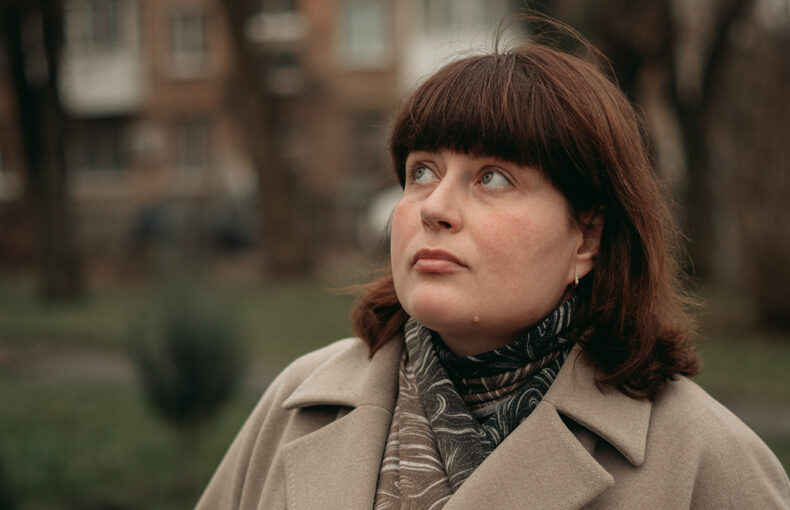
If you’ve ever imagined treasure hunters like Dumbledore or the Snow Queen, we’re sure you’re wrong. In real life, these are humble and intelligent people who care about preserving cultural heritage, are concerned with philosophical issues and profess moral values. Do you think it’s easy? Not at all! Especially when knowledge of the history of one’s own family and the state in general gives an understanding of the importance of preserving memory, cultural and ethnographic values, which are real treasures. We talked about the history and meanings with Yulia Kaplun, Deputy Director for Research at the Zhytomyr Museum of Local Lore
«I love my job. Why? I can’t explain, probably it is put in the childhood. My parents also loved their job, they both had two degrees and worked as teachers for a while, and the students loved them very much. You know, there are teachers, who just give information, and what will happen next, they are not interested. My mother, who had 30-40 students in the group, found a special approach to each. After her death at the pedagogical college where she worked, her memory was honored by a small museum. For some time, my father taught pre-service training and physical education at school. He taught his students to love sports, to value themselves. And his disciples, unlike others, found their way. The main thing is that they valued themselves. They were aware of their responsibility to their parents and society, but first and foremost to themselves»
«From each trip my parents brought home books, we read a lot. Once upon a time, at the age of eight, I had a strange selection of books: a collection of Arab fairy tales «1001 Nights», works by Victor Hugo and Fedir Dostoevsky (Laughs). My mother sang a lullaby to me based on Lermontov’s poems or memorized fairy tales by Pushkin, Marshak, and Chukovsky. Now I enjoy reading modern prose and fantasy. Well, how can you not love fantasy?»
«Without a strong economy there will be no development of culture, and without the revival of culture the economy will not be revived. These are very interconnected things. In my opinion, there was a time when there was a rise, but now I do not feel it. Although, in principle, it depends on the people themselves. It is important to understand that everyone should be responsible for their work in their place, just work well where they are. And if everyone works thoughtfully, humanely, then we will have a result. Because if one does, the second does not, and the third did not care at all… Such things should be taught to children, and adults should be explained and fined if they do not understand. There is no more effective motivating measure than a fine. When a person pays a fine that hits his wallet, it quickly disciplines him»
«When we talk about the formation of a creative personality, the intelligentsia, we must always understand that the environment is important. Remember Richter. If it weren’t for that old Zhytomyr with its literary, musical, and artistic centers, such a personality probably wouldn’t have formed. In his memoirs, Richter misses old Zhytomyr. In many memoirs, in films, especially in Bruno Montsenjon, he tells about a city that in fact no longer exists. And you see the world through Richter’s own eyes. You feel that he would never have become like this if his father had not played the piano, his uncles and grandfathers did not cook rosin, his aunt did not paint at the Syaivo publishing house. It all affects you, even if you don’t want to. The environment leaves an imprint»
«Historically, we need to realize that our cultural environment is divided into two parts. On the one hand, they are gentry, officials, nobles and people like Kravchenko (ed.: Vasyl Kravchenko – Ukrainian ethnographer, dialectologist, one of the founders of the Society of Researchers of Volyn). Although he was essentially a simple man, he achieved a lot because he worked on himself… And when the October Revolution took place, they began to seize estates, personal belongings, divide them, some intelligent people simply went abroad. But those who remained were quickly taught in the 1930s: those who were not destroyed were taught to be afraid»
«My great-grandmother came from a noble Bielski family. They used to live here, right next to our museum of local lore. She married an Austrian soldier who came here through the Crimea during the military events of 1917-1921, but in 1937 he was recognized as a spy for Poland and shot, great-grandmother and grandmother were also repressed, but during World War II, in February 1944. As ethnic Germans, they received assistance from the occupying power. When the Soviet authorities came, they received such assistance from the occupiers as treason, and they were sent north to the Montenegrin penal colony»
«Grandmother mentioned that almost all the women who lived here above Kamyanka went to Bohunia to the POW camp and threw bread at them over the fence. And then, when they allowed Ukrainians to take them home to save them, they took these typhoid boys with them. We have the grave of one of these prisoners of war, who died in the house of my grandmother’s godmother, in the old Russian cemetery (ed.: Vilske (Russian) cemetery – a historical Orthodox cemetery in Zhytomyr)»
«My grandmother lived in the North in a settlement, worked as a dentist in a children’s anti-tuberculosis sanatorium. She managed to return only in the sixties, when they had my mother, but not to Ukraine, to Moldova – they did not allow her to return here. There in Moldova, in a small village on the border with Ukraine, they settled… Once my grandmother told about her life in the camp, and those were scary stories. For example, when she got up in the morning, she tore off the braids with their roots and skin, which froze to the bunks on which they slept. How my great-grandmother died in captivity, how women had to load wagons with coal and firewood. This was done with shovels, thrown into cars through a small window. Hard work that completely killed her health. Women were dying. This is how the repressive system worked – it pressed and taught to be afraid»
«Every night our grandmother prayed, but she never did it in public on the street. I remember very well how she hid me behind the door and quickly baptized me before leaving the house so that no one, God forbid, would see me. Grandma taught us some household things, such as how to behave at the table. But it was not just about what forks to take or how to hold your elbows, but also about how to treat other people»
«… Vyatrovych, former director of the Institute of National Remembrance, urged us to respect ourselves as Ukrainians. Not Poles or Russians, but Ukrainians. He deprived us of the inferiority complex, taught us to be proud of our history. We realize that at all times there were those Ukrainians who could raise their heads, unite and resist pressure. I remember last year I was in Poland, where I met people from the museum community. One of the members of this community, an acquaintance of mine, is a teacher, a blogger, who tells people about the history of Northern Poland and historical processes. His wife also works with children. So he told how during the wave of protests against the ban on abortion, the entire intelligent community voluntarily went to rallies. If people could not leave the house, they protested on social networks. At the weekend, they rallied and went to Warsaw to protest. And what do we have? I just saw with my own eyes how our «protesters» were paid 500 hryvnias each. And I always asked myself, «When will we begin to respect ourselves, to value our thoughts and beliefs?»
«For some reason, we always put law first, not duty. Wherever democracy works, people realize that they will have rights only when they perform their duties. This is especially impressive when you come abroad. And not when you go with your family – all the same, we all create our own small society. That’s when you are alone in another country, you involuntarily immerse yourself in the environment completely. I’m joking that since my last trip to Poland I brought my jaw in a suitcase»
«It is scary when a generation of slaves grows up… We must learn to value ourselves, realize our past and understand what we can be proud of. Not only to complain, but to be proud of yourself, your history, your achievements»


