


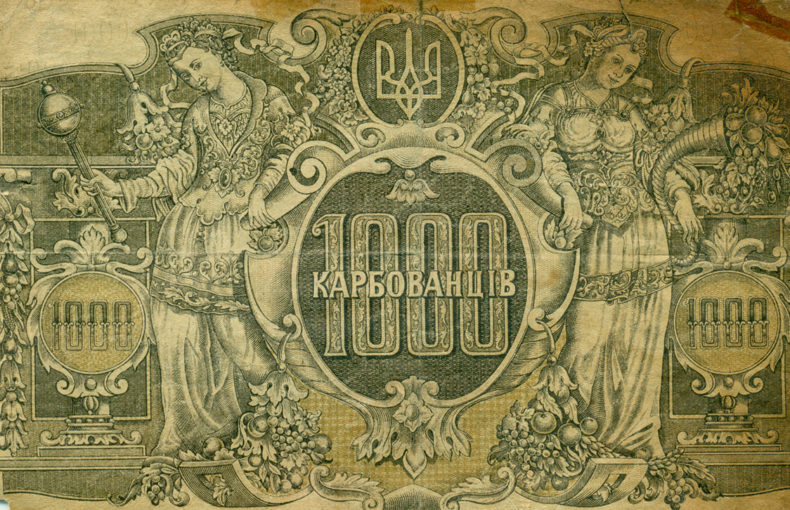
As a result of the revolutionary events of 1917 and the civil war, the Russian Empire split into a large number of state-owned tumors. And although in 1917 Ukraine was de facto part of Russia, in early summer, the Provisional Government stopped supplying money to a newly formed state. Before the new Ukrainian authorities there was a problem creating their own currency, and Zhytomyr is destined to play a significant role
Ukraine was one of the first to begin the restoration of its statehood: the Central Rada was formed in Kyiv, proclaiming Ukraine the People’s Republic and on January 9, 1918, declared its independence. Since October 1917, the Bolsheviks captured power, which at once, albeit in veiled form, revealed their negative attitude to the national statehood of Ukraine. The relations of the Central Council with the Council of People’s Commissars were extremely tense, the confrontation resulted in an armed conflict. Fierce fighting was carried out with varying success, but in general a few Ukrainian units could not hold back the onslaught of the organized regiments of the Bolshevik Army, which approached Kiev in late January. Fulfilled with fears of significant bloodshed and destruction of the capital, members of the Central Rada decided to withdraw Ukrainian troops from the city, and state authorities to evacuate to Zhytomyr. Here they were placed in the premises of a former noble assembly on the Velyka Berdychivska Street (now the city’s polyclinic № 1). Day of March 1, 1918 was marked by an event of great national significance. It was in Zhytomyr that the Central Council adopted a document that became extremely important for the entire financial system of Ukraine – the Law on the introduction of the monetary unit, the hryvnia.
Zhytomyr period was one of the most fruitful activities of the Ukrainian government, then a large number of basic laws of the state system were adopted there.
In 1918, the Council of Ministers of the UNR granted permission for the city of Zhytomyr to issue its own currency.
In the city, the practice of circulation of local money was already well known. Long before these events, the lack of the required amount of money supply was acutely noticeable. Zhytomyr belonged to those cities of Ukraine, whose farms suffered the most from frequent changes of power.
For two and a half years the power has changed 14 times! Initially, the designation signs of the Provisional Government pushed the “kerenka”, and then the bills of the UNR appeared.
After them it’s time for the banknotes of the Hetman state, and along with them there were periodically received money from the Austro-German, Polish troops with him, and later Soviet billing tickets appeared.
In addition, the State Bank granted the right to credit institutions in Zhytomyr to issue checks for the amount of deposits held at the bank. This right has been used by more than 10 institutions.
In total during the civil war in Zhytomyr, 12 organizations issued 54 different types of monetary units. But by the end of 1919, all local money had been canceled, they were exchanged for the money of the RSFSR.
Printing of Zhytomyr money was carried out in the private printing house of businessmen Uger and Blokh, who was on the Podilskaia street. At the time of printing in the premises of the printing house, workers of the Zhytomyr branch of the State Bank were on duty.
Later, the edition of tickets of the People’s Bank of Zhytomyr was already printed in the version of “Soviet money”, then in the image of the emblem of the city instead of a stylized castle tower appeared an abstract house. And the main thing is that the text of the banknote was printed in Russian.
Hence, the question of issuing the national currency disappeared from the agenda. The production of clichés, as well as the prints of a monetary sign of Ukraine, simply went away in history, and on the territory of Soviet Ukraine from that time and for 73 years there were money in circulation, printed in Moscow.
And although almost nobody remembers this, Zhytomyr can rightly be considered a place of birth of the hryvnia.
S.Sobchuk
Member of the National Union of Regional History of Ukraine
Translated by Aliona Matushevich


